

For the engineer selecting filtration equipment on an extrusion line, the key question is the operating problem: what reaches the filter, what happens during intervention, and what needs to improve.
Hydraulic operation and backflushing deserve separate questions. One describes how a mechanism moves; the other describes a cleaning function. A useful selection brief connects those functions to the line’s actual records, rather than treating either label as a complete answer.
Screen replacement and backflushing solve different tasks
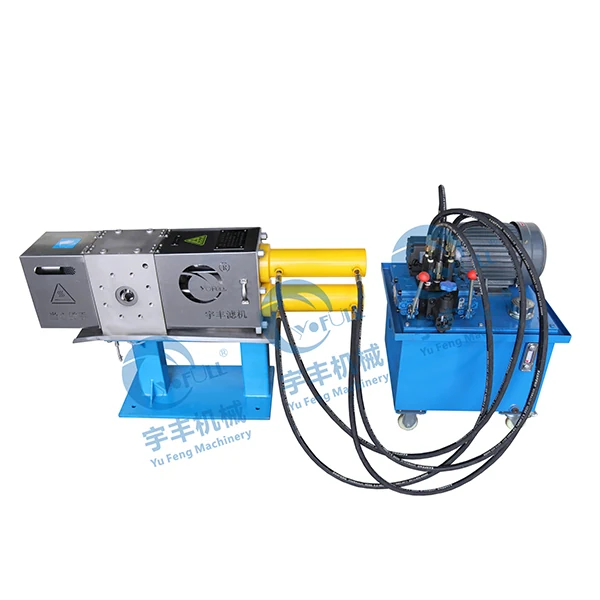
Yufeng’s hydraulic screen changer uses hydraulic force for screen changing. Its backflush screen changer includes automatic backflush cleaning of contaminants from the screen. These descriptions address different parts of the job. They should not be read as mutually exclusive categories.
For a proposed arrangement, ask the supplier to distinguish screen replacement from cleaning. Which action is automatic? Which requires an operator? After a cleaning cycle, under what conditions would the screen still need replacement? The answers belong in the equipment discussion before a model is selected.
A backflush function alone does not establish that every contaminant can be removed or that a screen can remain in service indefinitely. Likewise, hydraulic actuation does not, by itself, describe melt conditions during a change. Keep the function description separate from the performance that must be demonstrated.
What does the line’s contamination history show?
Bring a short record of the problem, preferably covering more than one material lot. Useful entries include the polymer and grade, recycled content where relevant, screen specification, production rate, recorded pressures, time between interventions, and the quality issue that prompted action. Note changes in the feed as well as changes at the filter.
Retained screens and representative product samples can give the supplier something more specific to discuss than “dirty material.” Where practical, identify whether the concern is visible particles, gels, or another observed defect. An unidentified defect should remain unidentified until there is evidence for its cause.
Gels need particular care. The public scope of ASTM D6265 notes that many gels can deform or break up under pressure and pass through wire mesh. A request to remove “all gels” therefore needs a clearer definition and an agreed assessment method.
For the selection discussion, separate observations from explanations. “Defects increased after a feed change” is a useful observation. It is not yet proof that a particular screen changer will resolve them.
Img.Backflush screen changer assembly.webp
Follow the melt through a change or cleaning cycle
Ask for a cycle description that follows the proposed equipment from normal operation, through intervention, and back to its normal state. A simple annotated drawing can be more useful here than a broad claim about continuous production.
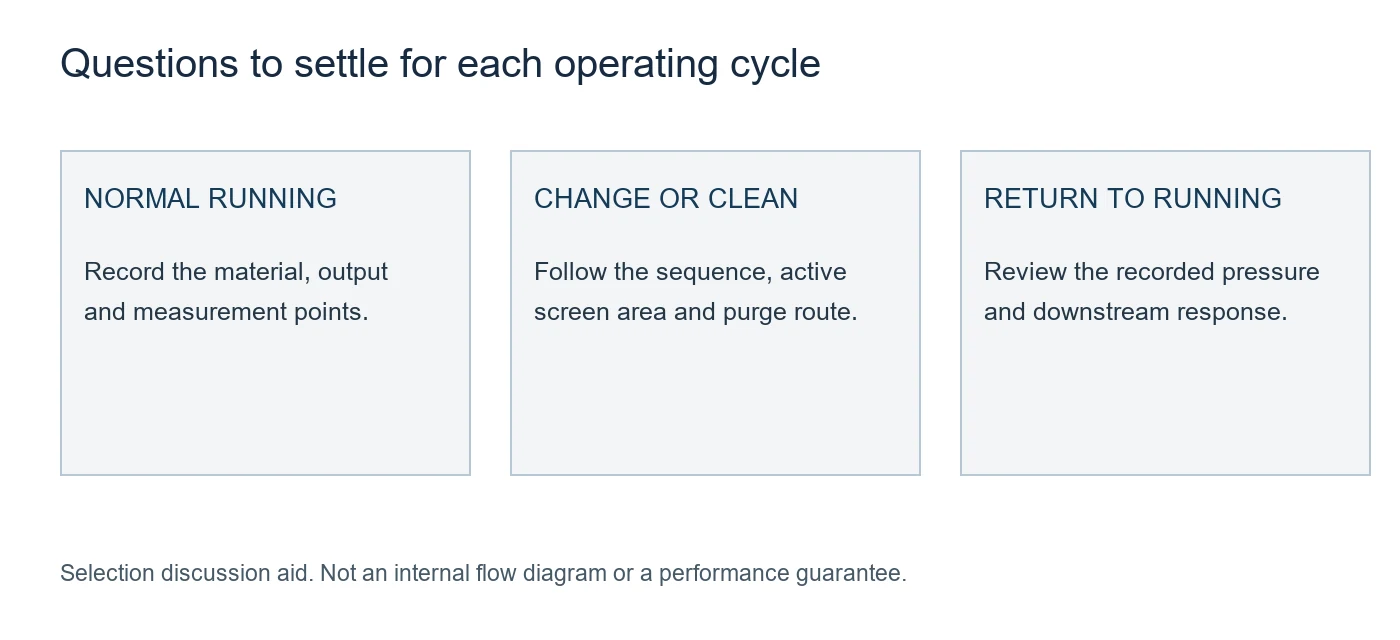
The cycle review should cover the melt route, the screen area available at each step, and any change in flow to the downstream process. It should also show how the action is triggered and what the operator can see. Ask which pressure and temperature signals are available, where they are measured, and how the sequence responds when a step is not completed as expected. These are questions to settle for the actual configuration, not assumptions to make from a product label.
If pressure stability is important to the downstream process, agree how it will be assessed during the cycle. Define the measurement points, operating conditions, recording period, and acceptable result together. A normal running value taken before a screen change does not describe the whole event.
The same approach applies to backflushing. Request evidence for the proposed cycle with relevant material conditions, and distinguish a controls demonstration from a melt trial.
Include purge loss, access and routine maintenance
The purchase discussion should also account for what happens around the machine. Ask how purge material will be collected and measured, what access is needed for routine work, and which tasks remain manual. Put these questions alongside the filtration requirements rather than leaving them until installation.
For a fair comparison, use the same boundaries for each proposal. Does a quoted material-loss figure cover one cleaning event, a screen replacement, startup, or a longer operating period? Which conditions produced that figure? Without a shared basis, two attractive numbers may describe different activities.
Maintenance deserves a practical review with the people who will do it. Request the relevant instructions and discuss screen consumption, access, tools, spare parts, and the planned working space. For hydraulic equipment, include the power unit and its routine maintenance in that review. Any safety procedure should follow the supplied instructions and the site’s requirements.
Where a demonstration is available, record the steps and operator involvement. A short cycle time is only one part of the maintenance picture. Preparation, recovery, and the next required intervention also belong in the discussion.
Turn the operating problem into a selection brief
A concise request for quotation (RFQ) can start with these selection inputs:
| Bilgi grubu | Dahil edilecek detaylar |
| Material and line | Polymer and grade; recycled content where relevant; output range. |
| Erime koşulları | Operating temperature and pressure; available pressure records. |
| Screen change | Current screen specification and reason for replacement. |
| Interfaces | Connection dimensions and available layout information. |
| Problem and evidence | Production issue and records needed to assess the proposal. |
For example, a line concerned about intervention-related variation might request a recorded change cycle under agreed conditions. A line considering backflushing might ask how cleaning effectiveness and eventual screen replacement will be assessed. Neither request requires a buyer to choose a model in advance.
Keep unresolved points visible. Mark missing measurements, uncertain contaminant descriptions, and trial conditions that still need agreement. That gives the supplier a clear basis for questions without turning estimates into specifications.
When ready to discuss screen changing and filtration requirements with Yufeng, bring that brief and the supporting records. The next step is a proposal that explains the relevant functions, the operating boundaries, and how the important claims can be checked on the intended application.