

Aceptación de filtros de polímero fundido: qué verificar en las pruebas FAT y SAT.
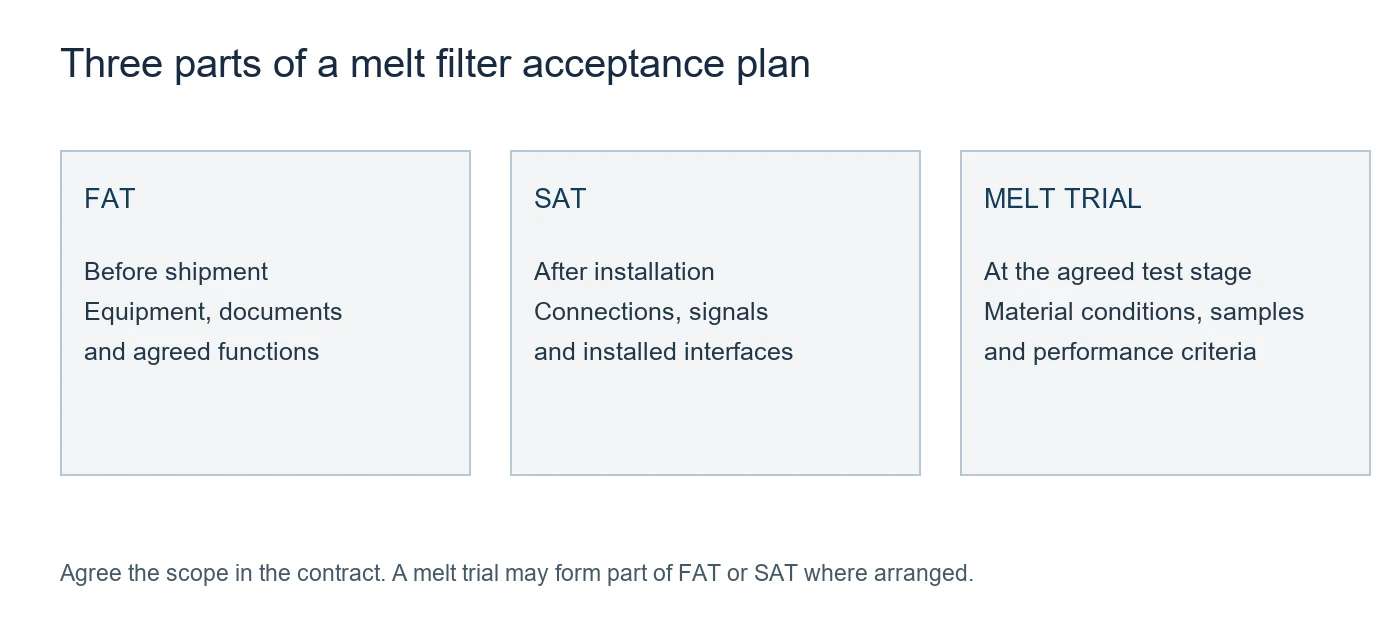
A polymer melt filter acceptance plan should make clear what has been checked before shipment, what still needs checking after installation, and which performance claims require a trial with melt. A signed checklist is useful only when those boundaries are clear.
Factory acceptance testing and site acceptance testing address different stages of a purchase. Neither label, on its own, defines the full test scope. For the project engineer responsible for acceptance, the practical task is to agree the evidence, responsibilities, and acceptance criteria before testing.
Agree what each test is meant to prove
A factory acceptance test, or FAT, takes place before shipment. A site acceptance test, or SAT, follows installation. General FAT references cover functionality, controls, and document checks; SAT brings the installed system and its operating context into the assessment.
For a melt filtration project, divide the proposed checks into three groups: equipment and documentation, installed interfaces, and material-dependent performance. Give each item a test stage, a method, an acceptance criterion, and a person responsible for recording the result.
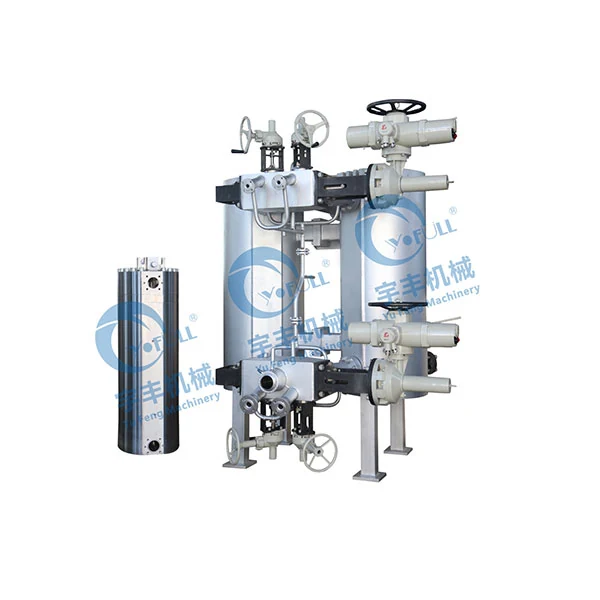
This separation matters when reviewing different equipment arrangements. Yufeng’s filtro de fusión de polimerización final is intended for terminal filtration in continuous polymerization lines. Its two-stage melt filter combines coarse and fine filtration. The acceptance plan should identify the arrangement actually ordered, without borrowing criteria from a different application.
Where something cannot be tested at the factory, record the reason and the agreed later check. “Not tested at FAT” should lead to a defined action, rather than an assumed pass.
At FAT: check the equipment before shipment
Start with the purchase specification and the agreed drawings. The proposed FAT checklist should identify the equipment, configuration, and document revisions being reviewed. Where the order specifies components, connections, or instruments, list the corresponding checks explicitly.
Document review can include the agreed manuals, drawings, and piping and instrumentation diagrams. Check that the supplied set matches the equipment presented for inspection. A discrepancy is easier to discuss when the report names the document and revision instead of simply recording “documents checked.”
For functional checks, agree which sequences will be demonstrated, which signals will be simulated, and what will be observed. Record the starting condition, action, expected response, and actual result. Where relevant to the supplied controls, discuss alarms, interlocks, and recovery steps with the responsible technical parties.
A simulation can provide evidence about a defined control response. It should be reported as a simulation. If no polymer melt is used, the report should leave material-dependent claims for the agreed trial rather than treating a successful sequence as proof of filtration performance.
At SAT: check the installed system and its interfaces
After installation, the proposed SAT should address the equipment as connected to the site. Use the agreed installation documents to identify the boundaries between the filter, upstream and downstream equipment, utilities, and plant controls.
Questions for the site checklist include whether connections match the approved arrangement, whether specified services are available, and whether the intended signals reach the correct control points. Agree who checks each interface. An item shared between suppliers still needs a named owner in the test record.
Review access for operation and maintenance as part of the installed arrangement. Ask the site team to identify any obstruction or unfinished work that could affect the planned checks. Record these observations separately from a claim that the system is ready for a performance run.
SAT results should say what was actually tested and under which conditions. If a check is postponed because another part of the line is unavailable, give it a new action and completion requirement. Avoid closing it with a general comment such as “to be confirmed during production.”
Use an agreed melt trial for performance claims
Before a trial, define the question it is meant to answer. Is the buyer assessing an agreed production rate, product quality, behaviour during an operating sequence, or another specified requirement? Each needs an agreed observation and a way to judge the result.
The trial record should identify the polymer, grade, relevant feed condition, filtration arrangement, operating settings, measurement points, sampling method, and test period. Agree these details before testing, including how deviations from the plan will be handled. Otherwise, a disagreement about conditions can become a disagreement about the machine.
Be precise about contaminant claims. The public scope of ASTM D6265 discusses separating contaminants in polymer samples and notes that gels may deform under pressure and pass through mesh. It does not provide a complete acceptance procedure for an industrial melt filter.
For any quality requirement, agree what will be sampled, how it will be assessed, and what result is acceptable. Keep the trial conclusion within those conditions. One successful run should not be rewritten as an unrestricted promise for every material or operating case.
Close open items before final handover
A short handover checklist gives the project engineer a record to close:
| Handover item | Details to record |
| Open item | Issue and effect on testing or handover. |
| Responsibility | Named party and agreed completion requirement. |
| Closure evidence | Record required, including any repeat-check result. |
| Documents | Outstanding documents and required revisions. |
| Release conditions | Priorities and handover conditions agreed by the project parties. |
Retain the test reports, relevant operating records, approved changes, and final document revisions together. If a correction requires a repeat check, name that check and attach its result when complete. A verbal assurance is a weak substitute for a traceable closure record.
Before placing an order, buyers can discuss melt filter acceptance requirements with Yufeng alongside the application brief. The useful outcome is a shared test scope: what happens before shipment, what happens on site, and what remains subject to an agreed melt trial.